


A Unified Digital Thread for Spacecraft & Satellite Engineering
Space programs require a highly controlled engineering environment where design, simulation, and manufacturing are tightly integrated. Kaizen PLM enables a connected digital thread that links requirements, system architecture, and validation data across the full lifecycle of spacecraft and satellite development.
Managing Complexity in Space Systems Engineering
Space systems must operate in environments that cannot be fully replicated on Earth, including vacuum conditions, extreme thermal cycling, radiation exposure, and high mechanical loads during launch. These constraints require simulation-led design validation from the earliest stages of development.
At the same time, space programs are distributed across global supply chains and must meet strict regulatory, security, and long-lifecycle operational requirements. Even small configuration errors can have mission-critical consequences.
To manage this complexity, aerospace organisations are increasingly adopting digital thread-based engineering environments that connect design, simulation, and manufacturing in a single controlled system. This allow for a continuous, integrated flow of data that connects all product lifecycle stages—from design and manufacturing to operations and maintenance—using tools like Teamcenter, NX, and Simcenter.


Additive Manufacturing
AM is rapidly revolutionising the aerospace, defence, and space sectors, and is transforming how products are designed, manufactured, and supplied. It enables aerospace and defense companies to reshape everything for optimal performance at reduced cost, in comparison to traditional manufacturing methods that require multiple steps, tools, and treatments to achieve the desired outcome. Our integrated software applications for additive manufacturing help you reimagine products, retool manufacturing, and rethink business models.


Engineer innovation with multiphysics computational fluid dynamics (CFD) simulation
Simcenter STAR-CCM+ is a complete multiphysics solution for the simulation of products and designs operating under real-world conditions, covering everything from launch aerodynamics to orbital thermal management.
The single integrated environment includes everything from CAD, automated meshing, multiphysics CFD, sophisticated postprocessing, and design exploration. This allows engineers to efficiently explore the entire design space to make better design decisions faster by creating a digital twin that simulates real-world conditions, reducing reliance on expensive physical testing.
Simcenter 3D Space Systems Thermal - Motion of an orbiting satellite
Simcenter 3D Space Systems Thermal helps the space industry by providing advanced simulation tools to predict and manage the extreme thermal environments spacecraft face, reducing physical testing needs and accelerating design cycles. It accurately models complex heat transfer (conduction, radiation) for orbiting vehicles, lunar rovers, and interplanetary probes. These capabilities allow engineers to optimize thermal performance early, reducing the risk of failure in the demanding environment of space.
With the Simcenter 3D Space Systems Thermal, you can model your craft's motion in orbit and conduct advanced radiation analysis while articulating your meshes.
See how Simcenter solutions can model lunar landscape and thermal distribution so that you can determine the optimum location to land your spacecraft.
Case Study: Revolutionizing Space Systems Design with OX Origin
OX Origin, a visionary Romanian aerospace startup, is bridging the gap between conventional space technology and modern engineering practices. To overcome the industry's reliance on outdated software, OX Origin partnered with Siemens to integrate a high-performance digital thread into their workflow.
By leveraging NX for design and Simcenter for simulation, the team can rapidly iterate and assess mechanical, thermal, and static performance, ensuring they select the optimal design for complex space systems.
Furthermore, using Teamcenter Share, they have streamlined global collaboration, providing a secure, cloud-based hub for real-time feedback and data management. This digital transformation has not only enhanced their proprietary solutions like StarLeap and MARS but is also empowering the next generation of space startups to reach for the stars.
Engineer innovation with multiphysics computational fluid dynamics (CFD) simulation
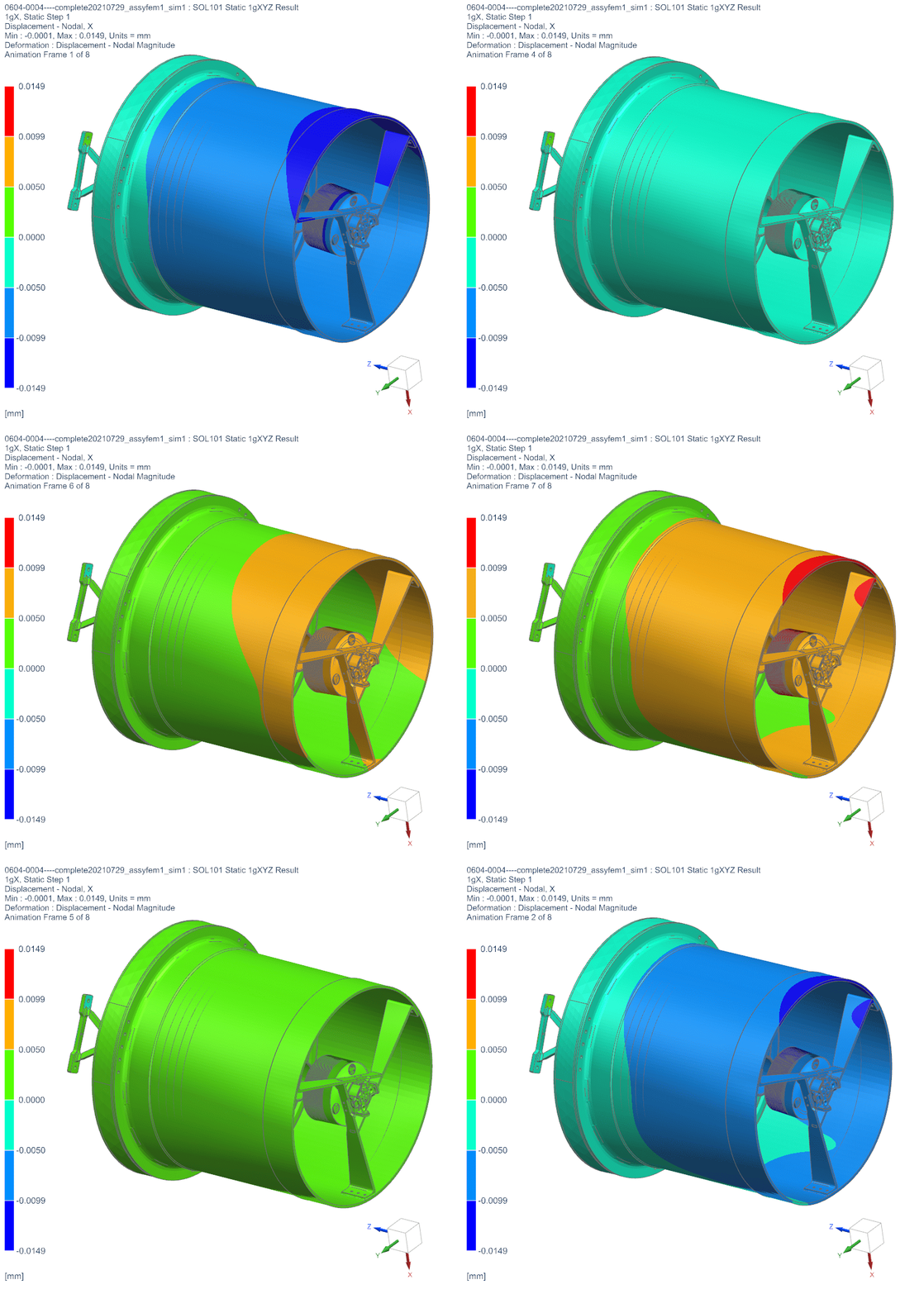
Simcenter Femap is a premier, CAD-independent pre- and post-processor used extensively in the space industry for high-fidelity finite element modeling (FEM) of rockets, satellites, and spacecraft, including NASA's Orion. It enables critical structural, thermal, and dynamic analysis, ensuring components can survive harsh launch and space environments while supporting lightweight design optimization.
Simcenter Femap serves the space industry by providing high-fidelity structural and dynamics analysis to ensure rockets and satellites can withstand the extreme vibrations of launch. Beyond structural integrity, engineers use it to model complex thermal environments and manage the performance of lightweight composite laminates, which are essential for modern spacecraft. It even handles advanced aeroelasticity simulations to study how aerodynamic forces interact with the vehicle's structure during flight.
Because it is trusted by major players like Lockheed Martin and used on high-profile projects like NASA's Orion, the software offers a proven track record for mission-critical reliability. Its deep integration with the Simcenter Nastran solver and superior CAD interoperability allow for rapid design iterations, often resulting in significant mass reductions and more efficient workflows. By streamlining the path from complex geometry to high-quality mesh, Femap helps engineering teams meet the strict safety and performance demands of deep-space exploration.

TEAMCENTER
MBSE: Model-based systems engineering
Product development without integrated architecture is like building without blueprints. System integration can consume as much as half of your program's resources. Start using model-based systems engineering (MBSE) early on for continuous integration.

See the free guide to using complexity to your advantage in the design and development of aerospace and defense products.
Popular solutions for the space industry
CAD, Systems Design & Digital Thread Backbone
CAD, Systems Design & Digital Thread Backbone
Modern spacecraft development begins with high-fidelity 3D design and systems architecture definition.
-
NX is used for advanced spacecraft modelling, structural design, and manufacturing-ready CAD development
-
Teamcenter provides the digital thread and lifecycle backbone, enabling configuration management, version control, and cross-organisational collaboration. It is widely used in aerospace programmes to ensure engineering traceability across long-duration missions.
Together, these tools form the foundation for managing spacecraft complexity from concept through to production.
Structural, Thermal & Multiphysics Simulation
Space systems must be validated against extreme physical conditions that cannot be fully replicated on Earth.
-
Simcenter enables multi-physics simulation including structural dynamics, vibration analysis, and thermal modelling.
-
Femap provides high-fidelity finite element modelling for structural validation of spacecraft components and assemblies.
-
NX Nastran delivers advanced solver capabilities for complex structural and mechanical analysis under aerospace load conditions.
These tools ensure spacecraft structures are validated early in the design cycle, reducing physical prototyping risk.
Thermal & Space Environment Engineering
Thermal performance is a critical constraint in spacecraft design due to orbital temperature extremes and radiation exposure.
-
NX Space Systems Thermal enables detailed spacecraft thermal analysis, including radiative heat transfer, orbital heating cycles, and subsystem thermal coupling.
This supports early identification of thermal risks and ensures system stability in low Earth orbit and deep-space environments.
Learn more about NX Space Systems Thermal >
Composite Materials Engineering
Lightweight composite materials are essential for modern spacecraft and satellite structures.
-
Fibersim is used for composite design and analysis, enabling engineers to define, simulate, and optimise composite layups for high-strength, low-mass aerospace structures.
This is particularly important for launch vehicle components and satellite structural frames where mass efficiency is critical.
Product Lifecycle Management & Requirements (Teamcenter)
Space programmes require strict control over system definitions, requirements, and configuration baselines across long development cycles and multiple organisations.
Teamcenter provides the central product lifecycle management backbone for space systems, enabling full traceability from requirements through to design, manufacturing, and validation.
Requirements management within Teamcenter ensures that mission objectives are captured, tracked, and linked directly to system and subsystem definitions.
Manufacturing Execution for Space Systems (Opcenter)
Space hardware manufacturing requires highly controlled production environments with strict process validation, quality assurance, and traceability.
Opcenter APS ensures that spacecraft are manufactured exactly as designed, with full visibility across production stages.
Siemens Xcelerator Portfolio for Space
Siemens Xcelerator provides a connected set of tools that support the full lifecycle of space systems — from early concept design through engineering, manufacturing, and operational feedback tailored for SMB's.
Core Xcelerator capabilities for space programmes include:
-
Integrated mechanical, electrical, and systems engineering
-
Simulation-driven spacecraft validation workflows
-
Lifecycle and configuration management across long-duration missions
-
Manufacturing execution and production traceability
-
Closed-loop digital twin integration from design to operations
This connected approach enables aerospace organisations to reduce fragmentation between disciplines and maintain control across increasingly complex space systems.

Electrical & Avionics Systems
Spacecraft power distribution, harnessing, and embedded electronics must be tightly integrated with mechanical and systems design.
Capital
This is the main Siemens electrical engineering platform used in aerospace and automotive.
What it does in space systems:
-
Electrical system architecture design
-
Harness design (cable routing across spacecraft structures)
-
Electrical schematics
-
Network & signal design
-
Cross-domain integration with mechanical + systems engineering
NX (Electrical Routing Integration)
NX also supports electrical + mechanical integration:
-
3D routing of wiring harnesses inside spacecraft structures
-
Physical space validation for cables, bundles, and connectors
-
Integration of electrical layout with mechanical design constraints
Teamcenter (Electrical Data Management Layer)
Teamcenter manages:
Electrical engineering in context:
-
Version control of electrical designs and schematics
-
Configuration management of avionics system variants
-
Linking electrical BOMs to mechanical and system BOMs
-
Cross-domain traceability (electrical mechanical requirements)